Summary: How will urban growth affect the long-run environment? This paper focuses on an overlook ed channel: how urbanization shapes environmental values and, with them, political support for environmental protection. Our theory combines two mechanisms: the extinction of experience documented by conservation science, whereby reduced contact with nature erodes attachment to it, and a cultural transmission process involving rational socialization decisions. Both are embedded in an overlapping-generations model with rural–urban migration and voting over environmental policy. When the extinction of experience dominates, urbanization erodes support for environmental protection. However, when socialization is effective, the picture reverses: the interaction between location and socialization choices gives rise to a process of cultural dissemination through which urbanization raises nvironmental values. Our main theoretical predictions are consistent with a set of stylized facts on environmental preferences, residential location, and policy support that we document using data from the International Social Survey Programme.
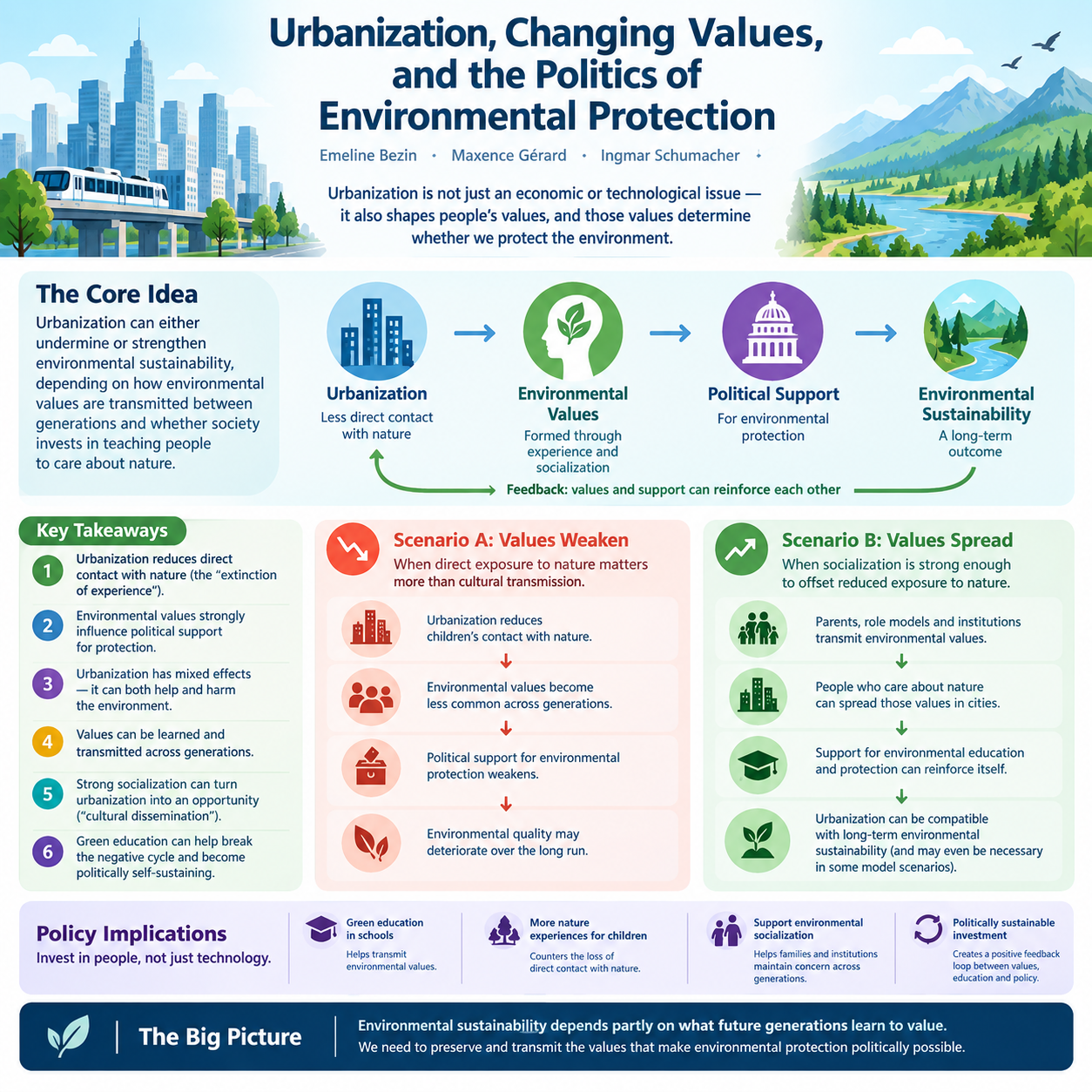
Main takeaways:
1. Urbanization reduces people’s direct contact with nature. People living in cities generally have fewer opportunities to interact with the natural environment. This can weaken their emotional connection to nature over time, a process the authors call the “extinction of experience.” If children grow up with less contact with nature, they may be less likely to value environmental protection as adults.
2. Environmental values strongly influence political support. People who feel more connected to nature tend to be more willing to pay higher prices or taxes, accept a lower standard of living, and protect natural areas. The authors find this relationship in international survey data, even after accounting for factors such as income, education, and political orientation.
3. Urbanization does not have a single, inevitable environmental effect. Cities can increase incomes and the resources available for environmental protection. However, urbanization can also weaken people’s connection to nature, reducing future support for environmental policies. Which effect dominates determines the long-term outcome.
4. Environmental values can be learned and transmitted across generations. Values are not necessarily fixed at birth. Parents can teach children to care about nature, and children can also learn from role models and other people in their communities. These processes can help maintain environmental concern even when direct contact with nature is limited.
5. Strong socialization can turn urbanization into an opportunity. When cultural transmission is effective, environmental values can spread through cities. People who care about nature may move to cities for better economic opportunities and then pass their values to children and others. The authors call this process “cultural dissemination.” Under the right conditions, urbanization can therefore help sustain environmental protection rather than undermine it.
6. Environmental education can help break the negative cycle. Schools and other collective institutions can help transmit environmental values, potentially compensating for reduced childhood exposure to nature. The authors show that green education can become politically self-sustaining under certain conditions, when support for education reinforces environmental values, which in turn strengthens political support for that education.
The big picture message:
Urbanization can either undermine or strengthen environmental sustainability, depending on how environmental values are transmitted between generations and whether society invests in teaching people to care about nature. The paper’s central argument is that protecting the environment is not just a technological or economic problem. It is also a cultural and political problem: people must value nature, pass those values on to future generations, and support policies that protect it. The paper suggests that environmental policy should address not only environmental damage, but also the formation of public preferences.
My co-authors:
Emeline Bezin is a CNRS research fellow at CREM (Centre de Recherche en Economie et Management, Rennes). Her research fields are environmental and urban economics. She is interested in the role of cultural change in the ecological transition. She is also working on social interactions, urban inequalities and crime.
Maxence Gérard is a postdoctoral researcher in the Center for Research in Economics and Management (CREM) at the University of Rennes. He works on the political economy of environmental policies, focusing on the role of behavioral motives, especially social identity. His research interests are at the intersection of environmental economics, behavioral economics, and political economy.
Link to the Working Paper: https://ingmarschumacher.com/wp-content/uploads/2026/10/ssrn-7524782.pdf

